Colonialism and the Climate Crisis: Exhibition at the United Nations headquarters, New York
I made this series of paintings to make explicit the link between colonialism and the climate crisis. Colonialism, both historical and ongoing, was identified as the driving factor of the climate crisis in the 6th annual report of the IPCC in 2022. This series was exhibited at the United Nations headquarters in New York, through June and July 2026. Deeply grateful to ICAAD (International Center of Advocates Against Discrimination) for the Artivist-in-residence grant that made this series possible, and the guidance and the creative freedom I received all along the making of this series.
Below are the nine paintings with the accompanying text where I share the ideas and inspiration that led to the art. Two of the nine paintings below did not make it through the selection process of the UN, which are Jal Jungle Zameen and Thirst World Countries.
-
Woman Stands Shining
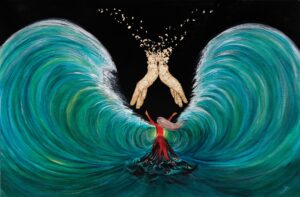
Acrylic and gold leaf on canvas
This painting was inspired by Pat McCabe, a Diné mother, grandmother, activist, artist, writer, ceremonial leader, and international speaker, and her relationship with water. She goes by the name Weyakpa Najin Win, which translates to Woman Stands Shining. On her website, she shares an experience that gives us an intimate peek into her relationship with water. The story starts in her hometown on a day when water started rushing out of the ground at around 8 gallons per minute. Pat talks about how she related to the water as a sister, to whom she could sing prayers to and make requests. And how the water responded to her requests.
Listen to the story in Pat’s words here:
Everything about this story goes against the modern, anti-animist worldview that sees the elements and the earth itself as “resource”, not relation. But it invites us to consider a new (well actually, old) way of relating to the elements – as family that we belong to and live in deep collaboration with. The phrase of the Indigenous Lakota people, “Mní wičhóni” (“Water is life”) was the protest anthem from Standing Rock heard around the world. Standing Rock is the sixth-largest Native American reservation in the US, and was the site
of huge protests in 2017 as the Dakota oil pipeline was slated to pass by Lake Oahe, the reservation’s only source of freshwater.
The Navajo or Diné are a Native American people of the Southwestern United States. The word ‘Dine’ is from their own language and means “the people.” The word “Navajo” comes from a Tewa-puebloan word “nava hu” meaning “place of large planted fields”.
The phrase “water is life” is rooted in Indigenous worldviews that recognize and respect the web of interdependence that underpins all life on the planet. As the climate crisis floods onto our doorsteps, a purely mechanistic, objectifying view of the elements might be the wrong handrail to continue gripping onto. I hope this painting evokes a bone-memory of deep connection with the ocean in all its unending ferocity and life-giving beauty. As Pat McCabe asks in one of her recent interviews, “The power-over paradigm we live under, the big systems we live under – health, economy, military – do not place life at the center. We are being asked now, do you want life or do you not want life?”
2. Jal Jungle Zameen – Water, Jungle, Land
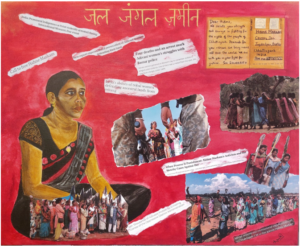
Collage and acrylic on canvas
“Jal Jungle Zameen” is the demand of the forest-dwelling communities in India whose survival directly depends on access to their land, water and forests. Accelerated exploitation of these, particularly through mining and other forms of economic degradation, has deprived Indigenous communities of their right to survival.
A former school cook, Hidme Markam is a 29-year-old Adivasi (Indigenous) activist who was arrested in March 2021 at a Women’s Day function where she was part of a protest against the death of another Adivasi activist in police custody. Hidme was arrested on a string of charges despite her name not matching the information the police had about the cases of which they were accusing her. A politically charged arrest, it was the state’s way of punishing her for her active, public stance against mining and violations of Adivasi rights.
Custodial violence against Adivasi women is rampant in a society where these women occupy the lowest rungs of various hierarchies. They have been paying with their lives for trying to protect their rights to live on their land. Acid attacks, sexual violence, public stripping and defamation are some of the consequences these women risk facing everyday for being part of the mining resistance movements.
Across the state of Jharkhand, Adivasi women have been standing in front of mine workers, using their words and bodies to stop the destruction of their lands.
As Shakuntala Topo, an Adivasi activist put it: “The Earth is our mother. We are the sons and daughters of this Earth so how can we watch anyone destroy our mother?” In Gandhamadan in the 1980s, women put their babies on the road in front of the police and bulldozers to show that future generations’ lives depend on stopping the mining.
Activist Soni Sori, who was present at the time of Markam’s arrest, said: “She isn’t a Maoist as police claimed. She has been fighting for Jal, Jangal, Jameen (water, forest and land) of tribals in Bastar. She had been going to the offices of the Superintendent of Police (SP) and Collector frequently and met with many prominent personalities…to raise tribals’ issues…have you ever heard of a Maoist going to the SP or Collector’s office, meeting the chief minister, governor and revealing their identity openly?”
“They tell us to leave their forest. But did the forest department give birth to the forests?”, asks Dasarath, a 60-year-old Adivasi man.
In April 2021, seven UN experts wrote to the Indian government to highlight Markam’s case and the government’s “misuse of the counter-terrorism legislation to criminalize human rights defenders and conflate their legitimate peaceful work with terrorism”. After no response was received, the letter was made public in June 2021. Hidme Markam was finally released in early 2023 from Jagdalpur Central Prison.
Sources:
3. Bon Appétit
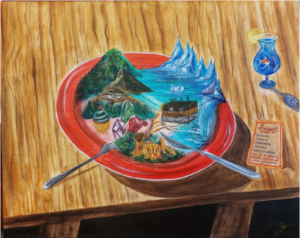
Acrylic on canvas
A twist on the mandatory food photo we take at restaurants moments before we dig in. It’s a similar voracious, devouring, eat-all-you-can attitude we bring to the world beyond our plates – with the stakes being far higher and consequences irreversible. Consumption is disastrously mistaken for satiation.
More consumption doesn’t equate to more satiation, much the contrary. Endless consumption is often celebrated as proof of success, abundance and prosperity. There’s only so much mindless consumption and extraction we can dig our way through before the “impossible physics of civilization” (as scholar and activist Tyson Yunkaporta put it) catches up with us. As the famous Cree Indian prophecy goes, “When the last tree has been cut down, the last fish caught, the last river poisoned, only then will we realize that one cannot eat money.”
If we shifted our priorities from consumption to collaboration, from natural “resources” to natural relationships, from owning the land to belonging to the land, we could slow down our race to the cliff’s edge and maybe even course-correct ourselves onto a life-centering path.
So many of the modern world’s “accomplishments” and excesses have been paid for by violently stolen land and labor of historically pillaged countries and future generations. It might be worth taking a good look at our grief-strewn relationship with the earth, lurking just underneath all the dents in its finite “resources” that we build our myopic, human-centered achievements on.
4. Lake on Fire
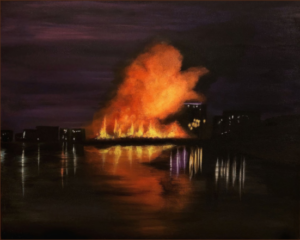
Acrylic on canvas
Bangalore’s lakes have been catching fire in the last decade. Bellandur lake and Varthur lake have caught fire repeatedly. Excess raw sewage and industrial effluents high in organic content entering the lake create anaerobic conditions for the build-up of gases. Such as methane, which is highly flammable. Treating sewage water before it is allowed into the lakes, not dumping garbage in the lakes, and checking encroachments are some measures we need to implement to prevent fires on lakes and the consequent public health hazards.
5. Colonizer Crisis
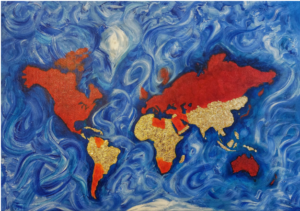
Acrylic and gold leaf on canvas
It’s hardly a revelation to point out that the colonized countries (that form most of the global South) bear the worst brunt of the climate crisis. Meanwhile, the colonizing countries of the global North are responsible for the highest emissions and for building their empires and “majesty” on the genocide of indigenous populations.
The gold leaf over the historically pillaged countries symbolizes the richness of all their cultural, economic wealth as it would stand if it weren’t stolen away to build empires and civilizations (using the term loosely) far away. I grew up hearing the phrase “third world countries” as a derogatory descriptor of countries like ours and those around it. A far more truthful label would be historically pillaged countries, but we know even our history books were written by colonizers who had no interest in owning up to the ugly truth of their centuries of violence and theft. British colonizers stole an estimated 45 trillion dollars from 1765 to 1938, which is approximately 9 times the annual GDP of Britain. The US military is the world’s largest institutional emitter of greenhouse gases with its 750 foreign military bases in 80 countries.
The crimson on the colonizing countries stands for the bloodshed that these countries built their cities on. A history that is too often glossed over and erased in favor of easier, more palatable stories of progress and adventure. The colonial dimensions of the climate crisis are more evident each passing week.
https://gain.nd.edu/our-work/country-index/rankings/
https://www.thelancet.com/journals/lanplh/article/PIIS2542-5196(20)30196-0/fulltext
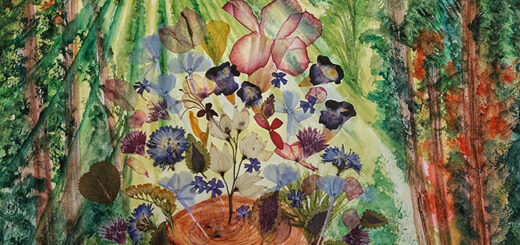
6. Apocalypse as Collapse-Renewal
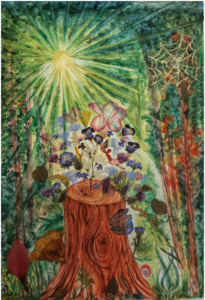
Watercolor and pressed flowers on paper
A dead tree is an infinite hotel – The Overstory by Richard Powers
With the climate crisis making itself loud and clear, the big apocalypse has never seemed this real and around-the-corner. Most people think of the apocalypse as the fiery end of everything after the earth has finally, irrevocably – and understandably – “had it” with our planet-destroying ways. Climate reports warn us of ever-narrowing windows of time before we cross a point of no-return and will have nothing but our own hubris to blame for fuelling this race to the cliff’s edge. Doomsday lurks around a corner, inching closer with every code red IPCC report. This seems to be the overarching narrative of the climate crisis for a lot of people, and for good reason. That apocalypse is no longer just the stuff of myth, but math. Global average temperatures, net carbon emissions, billionaire space jaunts and governments everywhere colluding with fossil fuel companies for profits – the math isn’t pretty.
In this painting, the idea was to depict a less common interpretation of the word Apocalypse.
I came across the work of Michael Meade, a well-known mythologist and author, where he talks about a less-known meaning of the Greek word Apocalypsis. One meaning being “lifting the veil”, and another being “collapse-renewal”. Not in the linear sense of collapse first, renewal later, but in an intertwined unfolding of both collapse and renewal simultaneously. The seeds of renewal finding life within the collapse. I find this to be a broader, more helpful understanding of the term. And a less anxiety-inducing one, you might agree. It doesn’t hold us hostage to modern culture’s linear time framework within a rapidly dwindling set of possibilities.
Apocalypse as collapse-renewal invites us to consider our place in the intertwined webs of collapse and renewal. What thread do we want to hold onto and weave while old plans unravel in the collapse, which seeds do we want to water? What dark, gnarly underworld swamps do we want to reach down into and put down our roots in, which sunbeams do we want to bask in? Both sides of the collapse-renewal coin invite our fullest involvement. The dead tree being just as much an infinite hotel is a great teacher of apocalypse as collapse-renewal.
7. Yaaté – That Feeling of Awe about this Life
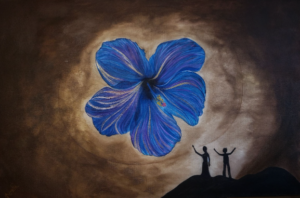
Acrylic on canvas
The first time I heard this word was in this speech by Pat McCabe, which she opened with the word “Yaaté” as her greeting to the audience. And then went on to explain how her elder explained the meaning of the word to her: “Out in the middle of the wilderness, if you were to see a magnificent waterfall with a rainbow spray all around it, and someone else comes along and they happen to see it, and you’re both staring at it. And then you look at each other and say, “Isn’t it amazing?”. That’s what Yaaté means, it’s our greeting to each other. It’s that feeling of awe about this life.”
A feeling not particularly evoked by our modern day greetings, useful as they may be. I found it interesting that the first word exchanged between people when they met was something that stood for deeply awed reverence of life. Human interactions beginning with this feeling of awe toward the earth point to a whole other framework for how one might live. A way of life that isn’t human-centered and extraction-based. But based on awe toward the earth and its incomprehensible magnificence. The kind of radical humility and surrender that stands in direct opposition to the extractive, colonizing mindset celebrated and rewarded by the planet-destroying systems we operate under. Indigenous people saw it as a way of life to honor nature, while the colonizer mindset sees nature as “resources” to endlessly extract from. The honoring of life on earth is necessary for survival. But the big systems underpinning our lives today place greed and profits at the center, not life.
What I hope to convey in this painting is that feeling of awe for life on earth. Which isn’t to be found only on the tops of mountains, or under the rainbow sprays of waterfalls. Awe is a lot closer than we give it credit for. Awe can be found in one whole-hearted gaze into a flower growing out of the soil under our feet, if one knows how to look. To quote the mythologist and story-teller Martin Shaw, we make things holy by the kind of attention we give them.
The Yaaté moment can happen wherever we humble ourselves in reverence for life, and if we decide to step back from the colonizer paradigm of the earth as a resource for us to endlessly extract, this earth-oriented awe might be exactly the place to begin.
8. Thirst World Countries
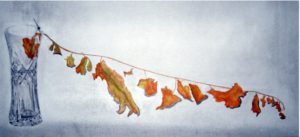
Pencil and watercolor on paper
“Long seen as a problem of only the poorest, the water crisis is increasingly affecting the wealthier nations, economic riches being no insurance against it. The management of water distribution will determine power relations, economic development, the relationship between rich and poor, and the destiny of countries and whole continents.” – World Water Federation Report: Rich Countries, Poor Water.
A twig with 18 leaves stretches across a bleak wall. A glass stands half full, leaving the leaves to wilt one after another. The leaves represent 18 countries which according to the Water Poverty Index released by the British Center for Ecology and Hydrology, will be first to be impacted by the water crisis.
Entire countries lining up for a glass of water seems a fitting analogy for just how important water is for our survival. Wealth and infrastructure are no insurance against scarcity, climate change and drought. Being economically ‘well-off’ or powerful is only a temporary defense, if at all, against a water crisis. “First-world” countries will have to get in line just as the “third-world” countries, and being way ahead in the queue will help, but not for long. Thirst is common to all, and as it so happens, the word itself is a portmanteau of the words third and first. There might be a clue in there for us.
From left to right the countries depicted are the United States, the United Kingdom, France, Norway, Sweden, Finland, Russian Federation, Japan, Australia, Brazil, Iran, Saudi Arabia, Mongolia, Myanmar, Zambia, Zimbabwe, Tanzania and Paraguay.
Source: https://www.ceh.ac.uk
9. Once Upon a Reef
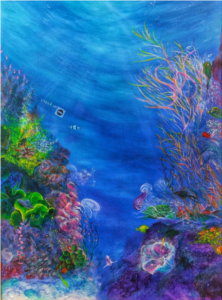
Acrylic on canvas
We know way less about the depths of our oceans than we do about outer space. Yet our terrestrial indifference and over-consumption continues to have violent repercussions deep into the oceans. As unfathomably vast as the oceans are, they aren’t mankind-proof. Here, man-made distress signals – a No Entry sign and an SOS signal – find their way into a pristine seabed, as ironic and fitting reminders to not intrude or meddle in places where we don’t belong and have never been invited. To not try to establish dominance where reverence is in order. Our global production of seafood has quadrupled over the last 50 years, and about half a million tons of fishing gear is discarded or lost in the oceans every year – causing untold damage to a multitude of species. Our unabated consumption of seafood, pollution that runs into our waterways, and disregard for marine ecosystems is destroying marine life at alarming rates.
Here’s to all the seabeds that no humans will ever lay their eyes, greed, or trash on. May they stay that way.
Sources: